MindUni In development
Emotional support for university students, with AI under clear rules.
An app that turns mental health care into a habit: supportive chats with Sage, short practices, a mood journal and progress that brings students back. With the CVV 188 crisis line always one tap away.
Project facts
- Role
- Product, design and development
- Year
- 2026
- Status
- In development
- Platform
- Android and iOS
01 / The problem
Distress shows up before help arrives
Anxiety, performance pressure and loneliness are part of daily life for many Brazilian university students. Counseling exists, but it often comes with waiting lists, limited hours and a high barrier to take the first step.
In that gap, students turn to whatever is at hand — often a generic chatbot with no rules for handling a crisis. The challenge was to offer daily support that feels welcoming and engaging, without pretending to be therapy and without letting the AI improvise when safety is at stake.
02 / The solution
A daily companion with well-defined limits
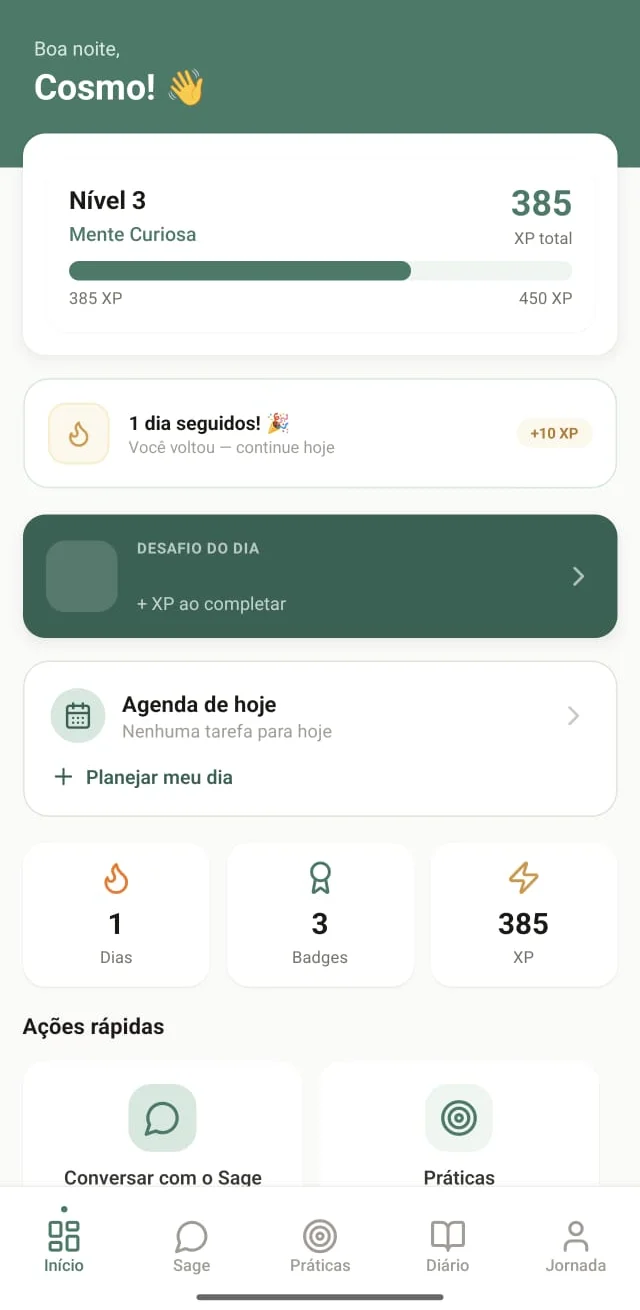
MindUni brings together, in a single app, what is usually scattered: a supportive conversation, short wellbeing practices, a mood journal and a reason to come back tomorrow. Students open the app, see the daily challenge, talk to Sage when they need to and follow their own progress.
The app is organized into five areas: Home, Sage, Practices, Journal and Journey. Each one has a clear role and none depends on the AI to work — Sage is one more resource, not the center of everything.
AI with rules, not improvisation
The most sensitive part of the project is safety. That is why the AI never decides on its own what to do in a risk situation:
- Deterministic guardrails: messages showing crisis signals are caught by fixed rules, on the device and on the server, before any generated reply.
- Immediate referral: when a rule fires, the app shows the CVV 188 crisis line and encourages seeking professional help.
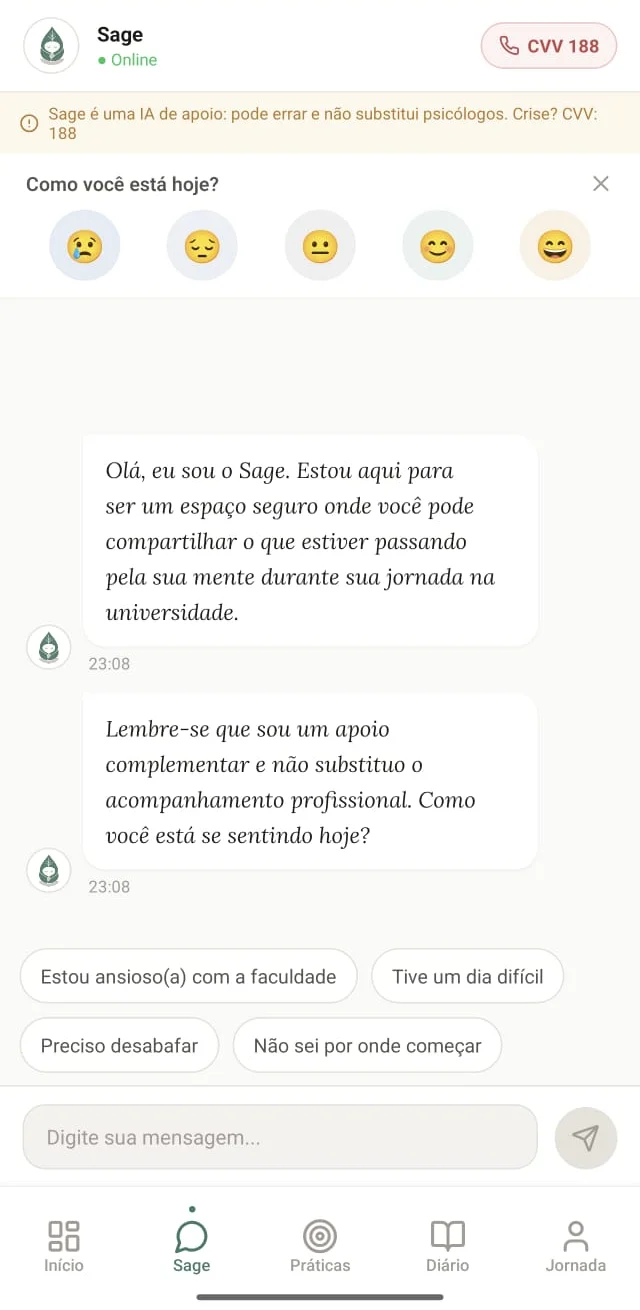
- Transparency: the notice that Sage is a support AI and can make mistakes stays visible throughout the chat.
Privacy as a requirement
Mental health data is sensitive data. Brazil’s LGPD (its data protection law) shaped the project from the first screens: consent recorded at sign-up, data access restricted to the user, and controls to wipe the history or permanently delete the account.
03 / Features
What the product delivers
-
Sage, a supportive chat
An ongoing chat grounded in Cognitive Behavioral Therapy techniques, a mood check-in that adjusts the tone, and memory of the conversation over the days.
-
Guided practices
Daily mindfulness, gratitude and breathing challenges with a timer and animation. They rotate every day so the habit never turns mechanical.
-
Mood journal
Five-level mood tracking, free-form entries and a trend chart so students can see how they are doing over time.
-
Progress that motivates
Levels, XP, day streaks and badges. Gamification rewards consistent self-care, not screen time.
-
Daily agenda
Quick task planning on the home screen, next to the daily challenge, so self-care fits into real routines.
-
CVV 188 always visible
A call button for Brazil's CVV crisis line at the top of the chat, plus crisis detection that stops the AI and shows the contact right away.
-
Privacy from day one
LGPD consent at sign-up, an in-app privacy policy, and options to wipe personal data or delete the account for good.
04 / Technology
Technical choices, and why
- Mobile app
-
- Expo
- React Native
A single codebase for Android and iOS, with fast updates and access to native features such as haptics and the camera.
- Data and accounts
-
- Supabase
- PostgreSQL
Authentication, a relational database with per-user access rules and server functions in one place — essential to isolate sensitive data.
- Artificial intelligence
-
- Gemini API
Fast, low-cost responses. Calls run on the server, never on the device, and go through the safety rules before any reply.
05 / By the numbers
The product in numbers
- 5areas in the app
- 1tap to the CVV 188 line
- 10progress levels
- 15badges
06 / Limits and ethics
What MindUni does not do
Making the limits explicit is part of the product. They show up in the app, not only on this page.
- It does not replace psychologists, psychiatrists or any clinical care.
- It does not diagnose or suggest medication.
- It does not let the AI handle a crisis: risk signals trigger fixed rules that show the CVV 188 line and point to professional help.
- It does not hide that it is an AI: the "may make mistakes and does not replace psychologists" notice stays at the top of the chat.
Next mission
Need an app or an AI-powered system?
Tell me what you need to solve. I will reply with a clear path: scope, timeline and what the AI should (and should not) do in your product.